Air Canada plane crashes
The following numbered events involved the deaths of one or more passengers and are fatal events as defined by AirSafe.com. Other event are included if they were significant in other ways, including events where the only passengers killed were stowaways, hijackers, or saboteurs; events involving injuries or aircraft damage, and events attracting significant media interest. Only events since 1970 are included.
- 5 July 1970; Air Canada DC8-63; CF-TIW; flight 621;Toronto, Canada:
The aircraft was on a scheduled domestic flight from Montreal to Toronto, Canada.
Shortly before touchdown, the sink rate of the aircraft increased, possibly due to the premature deployment of the ground spoilers.
The crew attempted to recover, and the number four engine struck the runway and broke away.
The aircraft was able to climb after losing the engine, but after several explosions the number three engine and part of the right wing separated when the aircraft was at about 3,000 feet (910 meters).
The aircraft subsequently crashed, killing all nine crew members and 100 passengers.
More on this event - 26 June 1978; Air Canada DC9-32; flight CF-TLV: flight 189; Toronto, Canada:
The aircraft was on a scheduled domestic flight from Toronto to Winnipeg, Canada.
During the takeoff, one of the tires on the right main landing gear burst, and the crew subsequently attempted to reject the takeoff.
Tire debris was ingested into engine two, causing compressor stalls and a reduction of reverse thrust capability.
The aircraft was not able to stop on the runway, ending up in a ravine.
All five crew members survived, but two of the 102 passengers were killed.
More on this event
DC9 plane crashes - 3 June 1983; Air Canada DC9-32; C-FTLU; flight 797; Cincinnati, OH:
The aircraft was on a scheduled international flight from Dallas, TX to Toronto, Canada.
While the aircraft was in cruise, the aircraft experienced electrical problems associated with the aft lavatory, and smoke from that lavatory area began to fill the cabin.
About 15 minutes after the first indication of electrical problems, the aircraft experienced the loss of several electrical systems, and the crew decided to divert to Cincinnati.
After landing, all five crew members and 18 passengers were able to escape before flames erupted in the cabin. However, 23 of the 41 passengers were killed
Of the 41 passengers, 23 were killed as a result of the fire and smoke.
More on this event
DC9 plane crashes
23 July 1983; Air Canada 767-200; C-GAUN; flight 143; near Gimli, Manitoba: The aircraft was on a scheduled domestic flight from Ottawa to Edmonton, Canada. The aircraft fuel gauges were inoperative, and prior to the accident flight, a maintenance crew had miscalculated the amount of fuel on board, and as a result the flight crew believed that they had more than twice the amount of fuel than was actually on the aircraft. During cruise, the crew received a low fuel pressure warning and attempted to divert to Edmonton. The aircraft ran out of fuel while over 100 km (62 miles) and could not make it to Edmonton, but were able to divert to a closed airfield at Gimli, Manitoba. None of the eight crew members or 61 passengers were seriously injured.
767 plane crashes
More on this event
16 December 1997; Air Canada CRJ-100ER; C-FSKI; flight 646; Fredericton, Canada: The aircraft was on a scheduled domestic flight from Toronto to Fredericton, Canada. Visibility at the arrival airport was limited by heavy fog. After the crew disconnected the autopilot shortly before touchdown, they attempted to abort the landing. The aircraft stalled and crashed during the attempted go-around. The aircraft contacted the ground to the left of the runway, crossed the runway, became briefly airborne after striking a ditch to the right of the runway, and finally came to rest after striking some trees. The aircraft was destroyed, but none of the three crew or 39 passengers were killed.
CRJ plane crashes
More on this event
10 January 2008; Air Canada A319; C-GBHZ; flight 190, near Cranbrook, Canada: The aircraft was on a scheduled domestic flight from Victoria, BC to Toronto, ON. The aircraft had a possible encounter with moderate to severe turbulence while in the vicinity of the Canadian Rockies. The turbulence was due to wingtip vortices caused by a United Airlines 747, which was flying about 10.7 nm (12.3 statute miles or 19.8 km) behind the 747 at the time of the turbulence encounter. After the encounter, the crew diverted the aircraft to Calgary. The aircraft was not seriously damaged, and there were three serious injuries, but no fatalities, among the five crew members or 83 passengers.
Related Resources: Turbulence Risks
Transportation Safety Board of Canada investigation report
A320 plane crashes
Podcasts About the Event
Audio: MP3
Video: iPod/MP4 | WMV | YouTube
For more videos, visit the AirSafe.com YouTube channel
28 January 2008; Air Canada 767-300; over Atlantic Ocean en route Toronto to London: The aircraft was on a scheduled international flight between Toronto, Canada and Heathrow Airport in London, carrying 146 passengers and nine crew members. According to the incident report, the first officer had arrived late for his flight, with the captain having already completed all preflight preparations before the first officer's arrival.
During the early phases of the flight, the first officer left the flight deck several times for short periods, and made it clear to the captain that he was tired.
At one point, the captain allowed the first officer to take a controlled rest break in cockpit. Over an hour later, as the aircraft was near the midpoint of its ocean leg, the first officer began to display unusual behavior, including rambling and disjointed conversation.
The first officer left the cockpit again, and after he returned he didn't follow proper cockpit reentry procedures, and also neglected to fasten his seat belt. It became apparent to the captain that the first officer was suffering from an unknown medical condition which impaired his ability to carry out his required duties on the flight deck. The captain summoned the lead flight attendant to get the first officer removed from the cockpit. The lead flight attendant removed the first officer with the help of other flight attendants. One of those flight attendants sustained a wrist injury during the removal.
After the removal of the first officer, the captain had the lead flight attendant check to see if there were any flight crew members among the passengers. None were on board, but one of the flight attendants held a commercial multiengine license, and she assisted the captain as the flight diverted to Shannon, Ireland.
Related Resources
Podcast about the event
Incident report from the Irish Air Accident Investigation Unit
767 plane crashes
29 March 2015; Air Canada A320-200; C-FTJP; flight 624; near Halifax, Canada: The aircraft was on a scheduled domestic flight from Toronto to Halifax, Canada. At the time the aircraft entered the Halifax area, visibility was limited due to both darkness and snowfall, and the aircraft entered a holding pattern before attempting a landing. During final approach, the aircraft touched down about 300 meters short of the runway, apparently hitting a combination of power lines and a localizer array before sliding onto the runway. The aircraft slid down the runway about 1000 meters, coming to rest just off the left side of the runway.
Damage to the aircraft included collapsed main and nose landing gear, both engines severely damaged, with the left engine sheared off, separated radome, and damage to the wings, stabilizers, and underside of the fuselage. While there was a fuel leak, there was no post crash fire. There were 23 injuries among the five crew members and 133 passengers.
More on this event
A320 plane crashes
7 July 2017; Air Canada; Airbus A320-200; C-FKCK; flight 759; San Francisco, CA: The aircraft was on a scheduled international flight from Toronto, Canada and San Francisco, CA. Shortly before midnight, the aircraft was on a visual approach to Runway 28R, but was apparently aligned with the Taxiway C, which parallels Runway 28R. The aircraft continued toward the taxiway and had overflown that taxiway by about 0.25 miles (400 meters) when ATC instructed the aircraft to go around. There were four aircraft lined up on Taxiway C at the time. The landing aircraft passed about 100 feet (30 meters) above the first two aircraft, 200 feet (61 meters) above the third aircraft, and 300 feet (91 meters) above the fourth aircraft. The closest lateral proximity between the landing aircraft and one of the four aircraft on taxiway C was 29 feet (nine meters).
Preliminary incident report and SFO airport diagram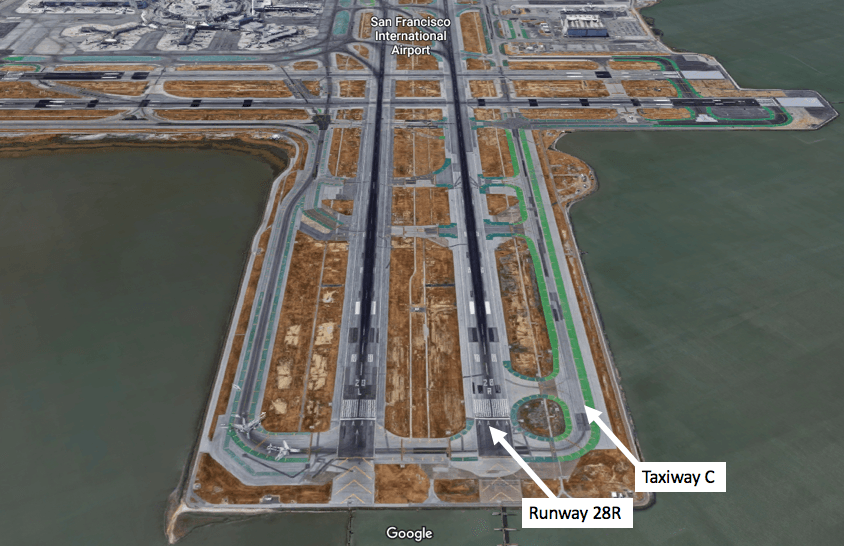
Airbus A320 plane crashes
Air Canada plane crashes
http://airsafe.com/events/airlines/aircan.htm -- Revised: 14 July 2017
http://airsafe.com/events/airlines/aircan.htm -- Revised: 14 July 2017